Get a free estimate.
Nassau & Suffolk County.
Sometimes the first sign of wind damage to a roof on Long Island is not a leak. It is a shingle lying in the driveway the morning after a storm, a ridge cap that suddenly looks uneven, or a few dark patches that were not visible the day before. The roof may still look mostly intact from the ground, but once strong winds get underneath roofing materials, damage can spread beyond the one missing shingle you can see.
JAGG Roofing, Siding & Windows provides roofing services throughout Nassau and Suffolk County, including roof inspections, storm damage repair, leak detection, and complete roof replacement when wind damage affects more than a localized area.
Why Long Island Roofs Are Vulnerable to Wind
Long Island sits in a location where roofing systems experience several types of severe weather. Strong thunderstorms can produce sudden straight-line winds, coastal storms bring prolonged gusts and heavy rain, tropical systems can create hurricane-force winds, and winter storms add snow, ice, and freeze-thaw cycles to an already stressed roof.
This is not just theoretical. During the July 4, 2026 Long Island severe thunderstorm event, the National Weather Service documented an 87 mph gust in Baiting Hollow, a 75 mph gust in Bayville, and numerous downed trees and wires across portions of Nassau and Suffolk County. The NWS New York storm archive also shows repeated damaging-wind events affecting the region throughout the year.
Coastal Weather, Thunderstorms, and Winter Storms
Wind does not need to come from a hurricane to damage roofing materials. The National Weather Service definition of a severe thunderstorm includes storms capable of producing wind gusts of at least 58 mph, and straight-line thunderstorm winds can become considerably stronger.
Even lower wind speeds can expose an existing weakness. The NWS notes in its high-wind safety guidance that isolated damage becomes possible with sustained winds around 40–50 mph. An older shingle with a weakened seal, loose metal flashing, or a poorly secured ridge cap may fail before a newer, properly installed component does.
What Wind Damage Looks Like on a Roof
Wind roof damage is not always dramatic. A homeowner may picture an entire section of roofing being torn away, but smaller changes are much more common.
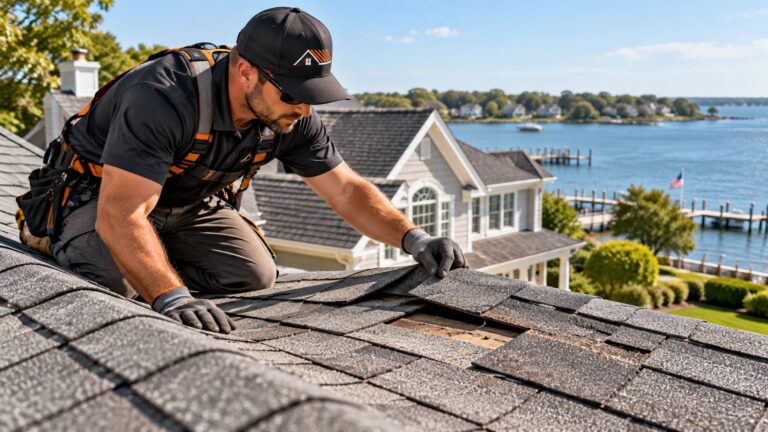
A professional roof repair inspection may uncover lifted shingles, broken sealant bonds, missing roofing nails, creases, exposed roof decking, loosened flashing, damaged gutters, or granule loss where shingles repeatedly flexed during high winds.
Heavy rain can make these problems worse. Once wind creates an opening in the roof system, storm-driven water has a path toward the underlayment, roof deck, insulation, and eventually the interior of the home.
Missing, Lifted, and Creased Asphalt Shingles
Asphalt shingles resist wind through a combination of nail fasteners, proper placement, material design, and the seal between overlapping shingles. When wind gets underneath a vulnerable edge, uplift pressure pulls against those attachments.
A shingle may lift and settle back into place without disappearing completely. That makes wind damage easy to miss from the driveway. Repeated movement can weaken the seal or leave a crease across the shingle. Other warning signs include missing shingles, torn tabs, exposed nail heads, granule loss, or a section that no longer follows the surrounding shingle pattern.
Homeowners considering replacement materials can review Owens Corning roofing systems and shingle options when comparing roofing materials designed for complete roof systems.
Ridge Caps, Valleys, Flashing, and Gutters
Roof edges and changes in geometry deserve particular attention because wind pressures are not distributed evenly across every part of a roof. Ridge caps sit at an exposed high point, while roof valleys carry concentrated water runoff. Metal flashing protects transitions around chimneys, walls, vents, and other penetrations.
High winds may also twist or loosen gutters, particularly when tree limbs or storm debris strike them. Gutter damage can create drainage issues after the wind has passed, allowing heavy rain to collect where the roof and exterior walls are already vulnerable.
What Wind Speed Causes Roof Damage?
There is no single wind speed at which every roof begins to fail.
Roof condition, age, roof pitch, exposure, installation, surrounding trees, building height, shingle seal strength, and flying debris all influence the outcome. A healthy roof may withstand a storm that damages an older roof nearby.
Wind Condition | Possible Roofing Concern |
|---|---|
40–50 mph sustained winds | Isolated damage may become possible |
58+ mph thunderstorm gusts | Severe-weather threshold; shingles and tree limbs may be damaged |
Higher severe-storm gusts | Greater risk of missing shingles, flashing damage and debris impact |
Hurricane-force winds | Substantial uplift and structural loads; widespread damage becomes possible |
A roof inspection after a significant storm is therefore more useful than assuming a roof is safe simply because the reported wind speed was below a product’s advertised rating.
How Shingle Wind Ratings Are Measured
Roofing shingles are tested under standardized conditions. The 2025 Residential Code of New York State roof requirements require asphalt shingles to meet wind-resistance classifications appropriate to the design wind speed. The code references ASTM D7158 and, for shingles outside its scope, ASTM D3161.
ASTM D7158 evaluates uplift resistance of sealed asphalt shingles and includes Class D, G, and H classifications. ASTM D3161 uses a fan-induced method to evaluate wind resistance of steep-slope roofing products.
This is why a phrase such as “130 mph wind protection” should not be interpreted as a promise that a roof cannot suffer damage below that number. Actual storms include turbulence, changing wind direction, debris, installation variables, aging seals, and different building exposures.
How Wind Damages Roof Decking and the Structure Below
Shingles are only the visible layer of a larger roofing system. Beneath them are underlayment, leak-barrier products, roof decking, and structural framing.
When enough roof covering is removed, wind pressure can act on materials that were never intended to remain exposed. The FEMA Wind Retrofit Guide for Residential Buildings emphasizes the importance of roof-deck attachment to framing when improving resistance to high-wind events.
JAGG evaluates the complete assembly when determining which roofing solution is appropriate for a Long Island home, rather than focusing only on the visible shingles.
Water Infiltration, Mold Growth, and Attic Moisture
Wind damage often becomes expensive because of what happens after the wind stops.
A lifted shingle or damaged ridge cap can allow water infiltration during the same storm. Water may reach the roof decking, attic insulation, ceilings, and walls before a homeowner notices ceiling stains. Persistent attic moisture can eventually contribute to wood deterioration or mold growth.
Winter adds another layer. The National Weather Service guidance on roof ice dams explains how repeated melting and refreezing can push water beneath shingles and into the attic. Wind damage, inadequate attic ventilation, snow accumulation, and ice formation can therefore compound one another during Long Island winter weather.
Can Wind Damage a Brand-New Roof?
Yes. A brand-new roof can suffer wind damage, although proper installation and modern roofing materials should improve its resistance.
Fresh shingles may need appropriate conditions for their sealant strips to form a strong bond. Installation errors such as incorrect nail placement, inadequate fastening, damaged starter shingles, or improperly installed ridge caps can also create vulnerable areas regardless of roof age.
Another factor is debris. Impact-resistant shingles are primarily designed around impact performance; that does not make a roof immune to a heavy tree limb or airborne object during a severe storm.
Research from the Insurance Institute for Business & Home Safety on roof weathering and wind vulnerability also shows that shingle sealants can weaken with age, increasing susceptibility to wind uplift over time.
What to Do After a Windstorm
Once conditions are safe, document what you can see without climbing onto the roof. PSEG Long Island’s storm preparedness resources are also useful after major weather events, particularly when storms cause power outages, fallen trees, or utility damage.
If you see downed wires or utility poles, stay away. PSEG Long Island specifically advises treating every downed power line as live and reporting it immediately.
A Safe Ground-Level Storm Damage Check
Before calling a roofing professional, homeowners can safely look for several clues from the ground:
- Missing shingles, ridge caps, or visible lifted sections
- Shingle fragments or unusual granule accumulation around the property
- Bent gutters, loose flashing, or displaced exterior materials
- Fallen tree limbs or other storm debris on the roof
- Water stains, attic moisture, or ceiling discoloration indoors
- Changes in the roofline that were not visible before the storm
Owens Corning’s roof storm damage checklist similarly recommends checking the roof, gutters, vents, windows, exterior areas, attic, and ceilings while documenting visible damage for possible insurance purposes.
Is Wind Damage Covered by Homeowners Insurance?
Wind damage may be covered when it results from a covered event, but the answer depends on the individual insurance policy.
The New York State Department of Financial Services explains homeowners insurance deductibles and windstorm coverage, including the possibility of separate windstorm or hurricane deductibles. Coastal homeowners in Nassau and Suffolk County should understand these provisions before a storm rather than discovering them during an insurance claim.
Take photographs, save repair estimates, record the date of the storm, and report suspected damage according to the insurer’s requirements. Wind damage and flood damage are also different insurance issues, so homeowners should not assume every type of storm-related damage is handled identically.
Should You Repair or Replace a Wind-Damaged Roof?
Not every storm-damaged roof needs replacement.
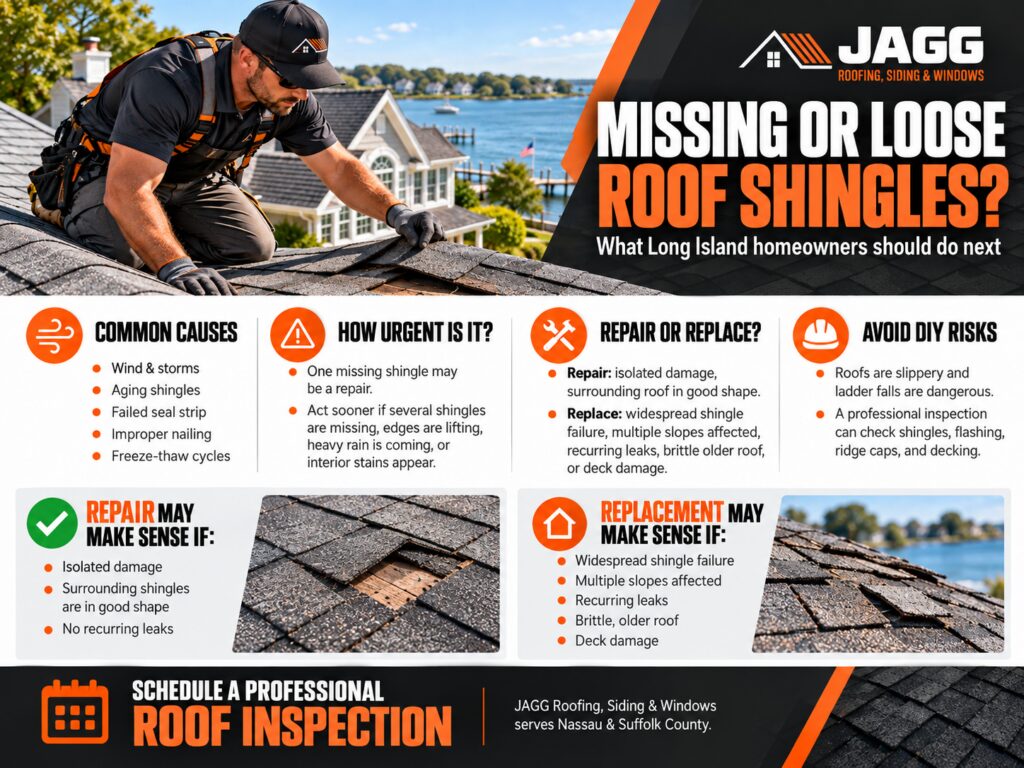
A few missing shingles, localized flashing damage, or one damaged ridge section may be repairable when the surrounding roofing system remains healthy. JAGG’s Long Island roof replacement guidance explains that replacement becomes more practical when leaks keep returning, materials are aging, or damage extends across several areas.
Age, granule loss, roof decking condition, repeated leaks, prior repairs, and the ability to match existing roofing materials should all be considered.
When a Repair Makes Sense and When Replacement Does
A repair generally makes sense when storm-related damage is isolated and the remaining roof still has meaningful service life. Replacement becomes more compelling when high winds expose widespread shingle failure, damaged decking, repeated water intrusion, or deterioration across multiple roof slopes.
This is why storm damage repair should begin with a complete inspection rather than a decision based only on the most obvious missing shingles.
Schedule a Long Island Storm Damage Roof Inspection
The tricky part about wind damage is that the worst problem may not be the shingle lying in the yard. It may be the shingle that lifted, broke its seal, and settled back into place while allowing water underneath.
JAGG Roofing, Siding & Windows provides storm damage inspections, residential roof repair, roof replacement, leak detection, and insurance documentation throughout Nassau and Suffolk County. If strong winds, heavy rain, hail damage, downed tree limbs, or a recent storm have you questioning your roof’s condition, schedule a professional roof inspection with JAGG before hidden water intrusion becomes a larger repair.
Jacob Giannelli is the founder of JAGG Roofing, Siding & Windows, serving Nassau and Suffolk County homeowners across Long Island. JAGG is an Owens Corning Preferred Contractor and BBB Accredited Business with a 5.0-star Google rating.