Get a free estimate.
Nassau & Suffolk County.
Replacing windows on Long Island can be a relatively straightforward home improvement project or a much larger investment depending on the number of windows, the condition of the existing frames, and the products you choose. A standard replacement window installed into a sound existing opening costs considerably less than a custom bay window, full-frame replacement, or project that uncovers water and humidity damage around the opening.
For homeowners in Nassau and Suffolk County, it helps to think about window replacement as more than the price of the window itself. The final cost may include professional window installation, removal of old windows, insulation, flashing, trim work, disposal, and repairs caused by moisture intrusion. Window style, frame material, glass performance, installation method, and even Long Island’s coastal conditions can all change the final price.
How Much Does Window Replacement Cost on Long Island?
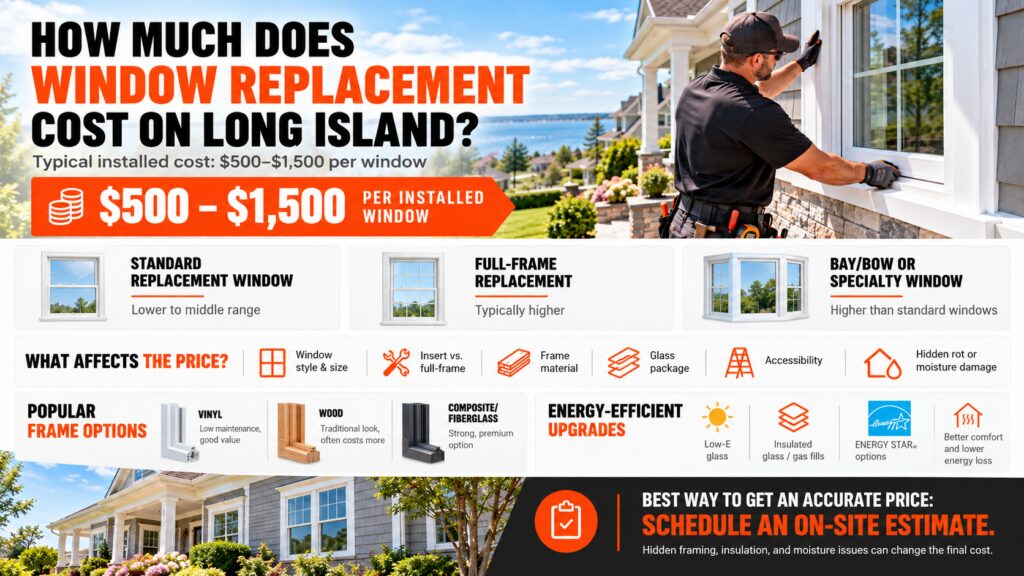
A reasonable starting point for budgeting is approximately $500 to $1,500 per installed window, with premium wood windows, composite or fiberglass frames, custom sizes, Bay/Bow Windows, and high-performance replacement windows potentially costing more. Specialty glass, structural changes, and full-frame installation can also push the price above the typical range.
That means a homeowner replacing three aging windows may face a very different total than someone completing a whole-home Windows & Doors Replacement & Installation project. The price per unit can sometimes become more efficient when multiple windows are completed together because setup, installation equipment, disposal, labor, and project management are spread across more openings.
Online pricing platforms can provide a useful starting point, but they cannot see the condition behind an existing frame or determine whether water damage, deteriorated trim, or poor insulation will require additional work. An in-home estimate or on-site inspection provides a much more accurate picture.
| Window Project | Typical Cost Position | What Can Increase the Price? |
|---|---|---|
| Standard replacement window | Lower to middle range | Upgraded glass, larger dimensions, premium frames |
| Full-frame replacement | Typically higher | Rot, moisture intrusion, insulation and trim repairs |
| Bay/Bow Windows | Higher than standard windows | Custom sizing, structural support, roofing and flashing |
| Basement window replacement | Varies by opening | Below-grade location, waterproofing concerns, egress requirements |
| Custom or specialty window | Varies significantly | Special shapes, impact-rated glass, custom finishes |
What Usually Fails First on Replacement Windows?
The entire window does not normally fail at once. Insulated glass seals, weatherstripping, caulking, balances, locks, or other moving parts can deteriorate while the frame remains usable.
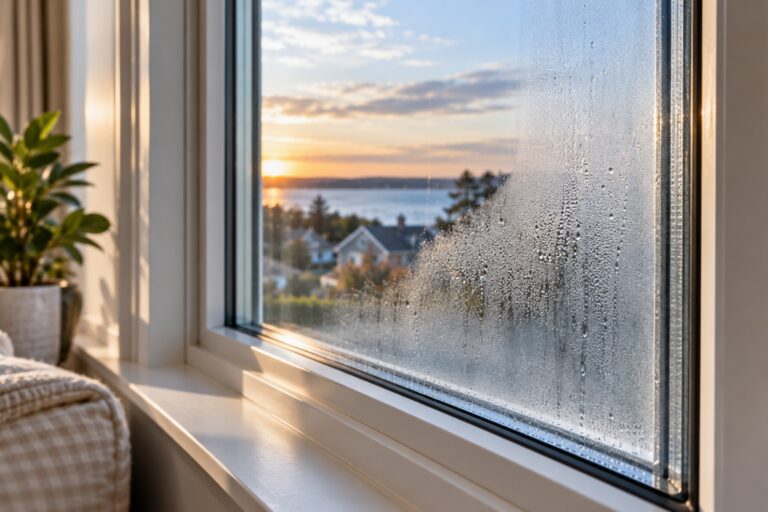
Condensation trapped between panes is one of the clearest signs of insulated glass seal failure. Pella states that moisture between dual- or triple-pane glass usually indicates that the glass seal has failed. Depending on the window design, the insulated glass unit or sash may be replaceable without removing the entire frame.
Drafts can have a different cause. Worn weatherstripping, an out-of-square sash, installation gaps, or failed caulking can allow outside air through or around the window. The source should be identified before assuming the whole unit needs replacement.
Commercial window projects can follow a different pricing structure because larger openings, storefront systems, curtain wall assemblies, glass railing coordination, access requirements, and commercial building codes may be involved. Homeowners comparing residential replacement windows should make sure the pricing they research applies specifically to residential work.
What Changes the Price of Replacement Windows?
Window size is only one part of the equation. Frame material, replacement window styles, glass configuration, accessibility, labor, and the condition of the surrounding wall all influence cost.
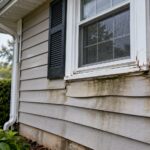
A second-story window that requires additional installation equipment may cost more than an easily accessible first-floor opening. Older Long Island homes may also contain nonstandard openings, outdated framing, or previous installations that were not properly sealed. Once the old unit is removed, moisture intrusion, damaged wood, missing insulation, or deteriorated exterior materials can add work that was impossible to see beforehand.
The number of windows matters as well. Replacing one failed unit can solve an isolated problem, while homeowners experiencing drafts, fogged glass, difficult operation, poor indoor comfort, and rising energy costs throughout the house may find that a larger window replacement project makes more sense.
Insert Replacement vs. Full-Frame Installation
An insert replacement places a new window inside an existing frame that is still structurally sound. More of the original trim and surrounding materials remain in place, which can reduce demolition and finishing work.
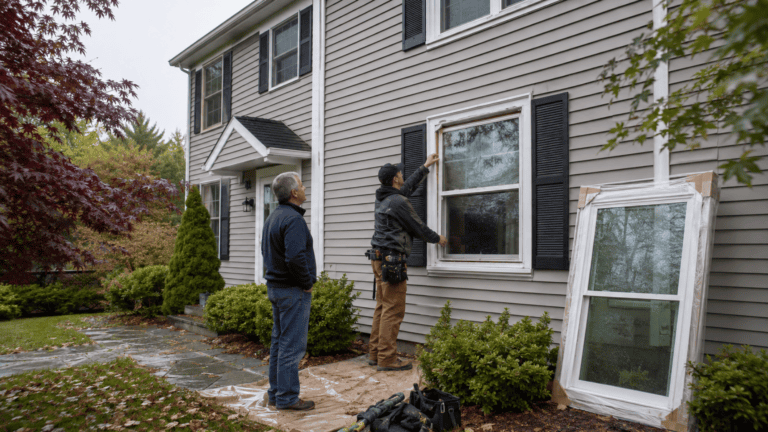
A full-frame installation removes the existing window assembly down to the rough opening. This gives the installer access to insulation, flashing, framing, and water-management details that remain hidden during an insert installation. JAGG evaluates the existing opening before recommending either approach rather than assuming every window should be replaced the same way.
Full-frame replacement typically costs more, but it can be the better investment when there is rot, water and humidity damage, poor prior installation, deteriorated framing, or inadequate airtight seals around the existing window.
Vinyl, Wood, Composite or Fiberglass Frames and Glass Options
Vinyl Windows are common on Long Island because they offer relatively low maintenance and good energy performance at an accessible price point. Wood Windows can provide a more traditional architectural appearance but generally require more maintenance and often cost more.
Composite or Fiberglass Frames are another option for homeowners prioritizing strength, dimensional stability, and long-term performance. JAGG currently works with vinyl and fiberglass frame options depending on the project.
Glass packages can change the price just as much as the frame. Double-pane insulated glass is common, while Low-E coatings, gas fills, laminated glass, triple-pane configurations, and impact-rated glass may increase cost. Homes exposed to stronger coastal weather may place greater emphasis on durability, air infiltration resistance, and Coastal Resilience.
The best way to compare high-performance replacement windows is through measurable performance data. Look at U-factor, solar heat gain coefficient, air leakage, NFRC ratings, and ENERGY STAR® eligibility rather than choosing a product solely because of a brand name, lifetime warranty, or marketing claim.
How Replacement Window Styles Change the Budget
Different replacement window styles use different amounts of framing, glass, hardware, and labor. A standard double-hung window will usually be simpler to manufacture and install than a large bay or bow configuration extending beyond the exterior wall.
Double-hung windows remain common in Long Island Colonials, Capes, ranches, and split-level homes. Casement windows open outward and can provide strong ventilation and tight compression seals. Sliding windows work well in wider openings, while picture windows maximize natural light without operating hardware.
Bay/Bow Windows are more involved. Their projected design can require additional structural support, exterior finishing, insulation, flashing, and sometimes a small roof assembly above the window. Specialty shapes and oversized picture windows may also require custom-built products.
Basement window replacement brings a different set of considerations. If a basement window is below grade, contractors may need to evaluate drainage, surrounding masonry, waterproofing, and the possibility of moisture intrusion. When a basement window is intended to serve as an emergency escape opening, applicable egress requirements also become part of the project.
That is why comparing quotes only by the number of windows can be misleading. Ten standard double-hung windows and ten custom architectural windows can represent completely different levels of material, labor, and installation complexity.
Energy-Efficient Windows, Energy Savings and Long Island Weather
Energy efficiency is especially relevant on Long Island because homes experience cold winters, humid summers, strong coastal winds, and frequent temperature changes. Older single-pane windows, failed seals, worn weatherstripping, and gaps around frames can allow conditioned air to escape and make rooms noticeably less comfortable.
ENERGY STAR® certified materials and properly installed high-performance replacement windows are designed to reduce heat transfer and air leakage. Features may include insulated glass, Low-E coatings, improved frame construction, warm-edge spacers, gas fills, and tighter seals.
The product itself is only part of the equation. Even an expensive energy-efficient window can underperform if the opening is poorly prepared or the unit is not properly insulated and sealed. Professional window installation should create continuous, airtight seals while managing exterior water so rain does not migrate behind trim, siding, or framing.
For Long Island homeowners, that can translate into better Energy Savings, more consistent indoor comfort, fewer cold drafts near windows, and reduced stress on heating and cooling equipment. Energy-efficient and eco-friendly windows may also be attractive to homeowners looking to reduce unnecessary household energy consumption over the long term.
Coastal Resilience should be considered in exposed locations as well. The appropriate window may depend on wind exposure, water management, frame strength, glazing, exterior finishes, and how the window integrates with surrounding siding and roofing materials.
Homeowners researching old articles should be careful with incentive information. The federal window tax credit that previously applied to qualifying projects ended after December 31, 2025. New York programs and utility incentives may still change over time, so current eligibility should always be verified before counting a rebate toward the project budget.
Planning a Window Replacement Project in Nassau or Suffolk County
Start with the condition of the existing windows rather than choosing a budget from an advertised price. Look for condensation between panes, cold drafts, windows that will not stay open, deteriorated frames, damaged locks, loose hardware, water staining, and rooms that become noticeably hotter or colder near the glass.
A professional in-home estimate should identify the window styles being proposed, frame material, glass package, installation method, insulation, trim, removal and disposal, and any additional exterior work that may be required.
For homes undergoing several upgrades at once, window installation can also be coordinated with broader exterior solutions such as vinyl siding or siding installation. Replacing windows and siding as part of the same exterior project can make it easier to address flashing, trim, insulation, and water-management details where the systems meet.
Customer service and quality control matter too. Homeowners should know who will measure the openings, who will perform the installation, how property protection and cleanup are handled, what the warranty covers, and how concerns are addressed after installation.
<details style=”margin:24px 0; padding:16px; border:1px solid #ddd; border-radius:6px;”> <summary style=”font-weight:600; cursor:pointer;”>What should be included in a window replacement estimate?</summary> <div style=”padding-top:12px;”> A detailed estimate should identify the number and style of windows, frame and glass specifications, insert or full-frame installation, labor, insulation and sealing, interior or exterior trim, removal and disposal of old windows, warranty coverage, payment terms, and any known repairs around the openings. Comparing these details is more useful than comparing the bottom-line price alone. </div> </details>
<details style=”margin:12px 0; padding:16px; border:1px solid #ddd; border-radius:6px;”> <summary style=”font-weight:600; cursor:pointer;”>Can new windows reduce monthly energy costs?</summary> <div style=”padding-top:12px;”> They can. The actual savings depend on the condition of the existing windows, HVAC efficiency, insulation, air sealing, window specifications, and installation quality. Replacing older drafty or single-pane windows with properly installed energy-efficient units can improve both efficiency and indoor comfort. </div> </details>
<details style=”margin:12px 0 24px; padding:16px; border:1px solid #ddd; border-radius:6px;”> <summary style=”font-weight:600; cursor:pointer;”>How do I get an accurate window replacement price?</summary> <div style=”padding-top:12px;”> The most reliable approach is an on-site or in-home estimate where each opening can be measured and inspected. This allows the contractor to account for the existing frames, trim, siding, accessibility, moisture damage, installation method, glass package, and any custom sizing before providing a written price. </div> </details>
Permit requirements can vary between towns and villages throughout Nassau and Suffolk County, particularly when the size of an opening changes, structural work is involved, or a new egress window is being created.
JAGG Roofing, Siding & Windows provides professional window replacement and window installation throughout Long Island. Available configurations include double-hung, casement, sliding, picture, bay, bow, and specialty windows, with insert and full-frame installation selected according to the condition of each opening.
Homeowners can request a Free Estimate and on-site consultation to compare replacement window styles, materials, energy-performance options, and installation requirements before deciding what makes sense for their home.
Jacob Giannelli is the founder of JAGG Roofing, Siding & Windows, serving Nassau and Suffolk County homeowners across Long Island. JAGG is an Owens Corning Preferred Contractor and BBB Accredited Business with a 5.0-star Google rating.