Get a free estimate.
Nassau & Suffolk County.
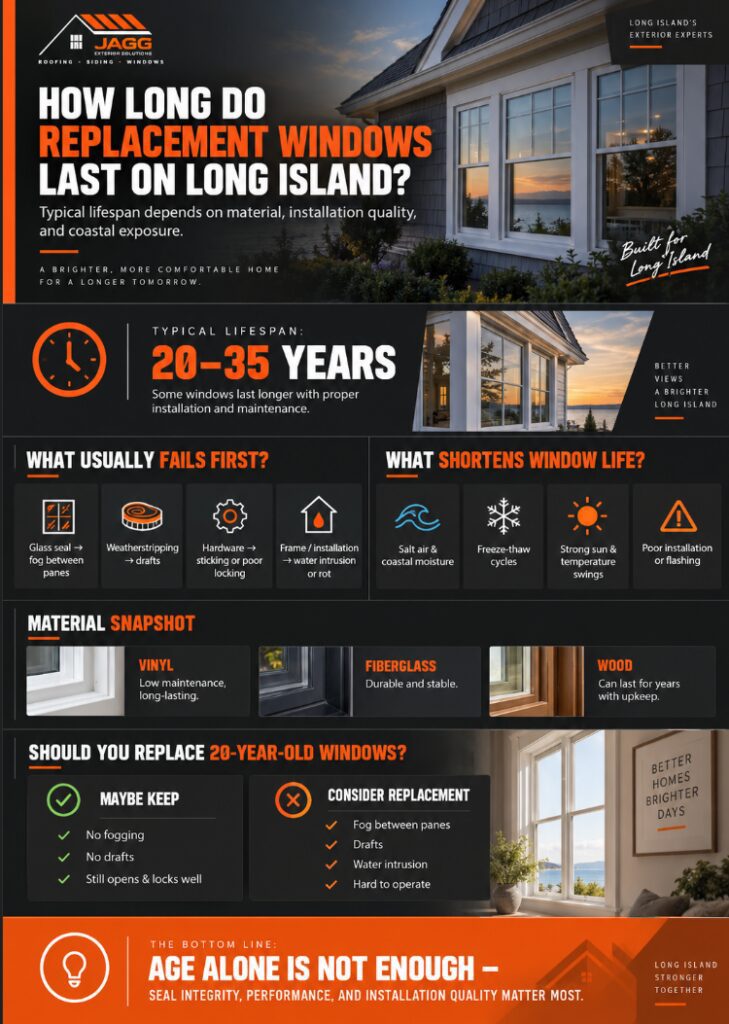
Replacement windows are not a once-in-a-lifetime purchase for every home, but quality products installed correctly can last for decades. For Long Island homeowners, a realistic planning range is often about 20 to 35 years, with some windows lasting longer depending on frame material, glass system, maintenance, exposure, and installation quality.
Long Island’s climate matters. Windows here deal with humid summers, cold winters, coastal winds, salt air near the shoreline, and repeated temperature swings that can stress seals, caulking, hardware, and frames. A 20-year-old window that still operates smoothly, stays dry, and seals tightly may have useful life left, while a newer window with failed glass seals or water intrusion may already need attention.
How Long Do Replacement Windows Last on Long Island?
Most replacement windows should be viewed as a multi-decade home improvement. A common planning range is roughly 20 to 35 years, although product quality, exposure, and installation can move the actual lifespan in either direction.
Vinyl windows are popular because they are low maintenance and resist rot. Fiberglass frames are also durable and stable, while wood windows can perform for many years when exterior finishes and moisture protection are maintained. ENERGY STAR notes that vinyl, fiberglass, wood, aluminum, combination, and composite frames each have different insulation and durability characteristics.
The glass system matters too. Double- and triple-pane windows rely on an insulated glass unit with perimeter seals, spacers, and often argon or another insulating gas. A frame may remain structurally sound even if the insulated glass seal fails first.
|
Window Component |
Common Warning Sign |
|---|---|
|
Insulated glass unit |
Condensation or fog between panes |
|
Weatherstripping |
Drafts around a closed window |
|
Hardware |
Sticking, difficult operation, poor locking |
|
Frame / installation |
Water intrusion, rot, gaps, or movement |
What Usually Fails First on Replacement Windows?
The entire window does not normally fail at once. Insulated glass seals, weatherstripping, caulking, balances, locks, or other moving parts can deteriorate while the frame remains usable.
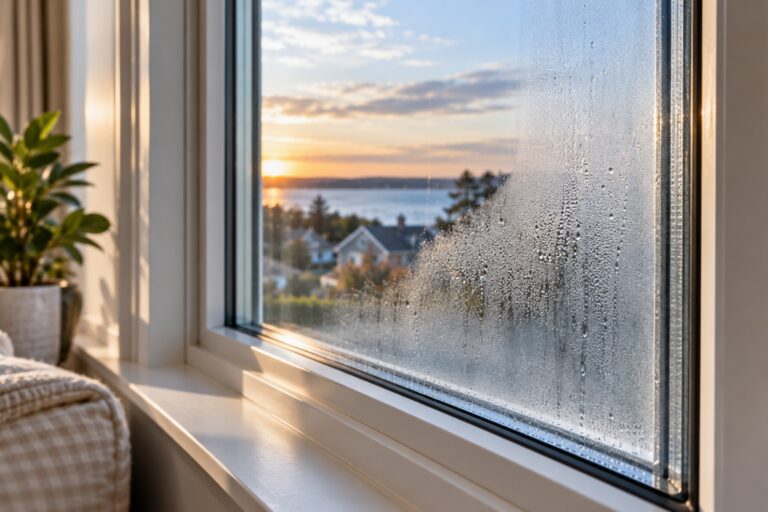
Condensation trapped between panes is one of the clearest signs of insulated glass seal failure. Pella states that moisture between dual- or triple-pane glass usually indicates that the glass seal has failed. Depending on the window design, the insulated glass unit or sash may be replaceable without removing the entire frame.
Drafts can have a different cause. Worn weatherstripping, an out-of-square sash, installation gaps, or failed caulking can allow outside air through or around the window. The source should be identified before assuming the whole unit needs replacement.
Does Fiberglass Last Longer Than Vinyl?
Both can provide long service lives. ENERGY STAR describes fiberglass frames as strong, durable, low maintenance, and good insulators. Vinyl frames are also low maintenance and provide good thermal insulation.
Fiberglass is relatively dimensionally stable, which can be useful where windows experience repeated temperature changes. Vinyl remains a strong choice for homeowners who prioritize low maintenance and value.
Product construction, frame reinforcement, glass package, drainage, installation, and maintenance can matter as much as the material itself. A quality vinyl window installed correctly can outperform a poorly installed premium product.
How Long Island Weather Can Shorten Window Life
Coastal weather places repeated stress on window assemblies. Wind-driven rain can expose weak flashing and exterior caulk, while salt air may contribute to corrosion of susceptible hardware or metal components. Strong sunlight and temperature swings repeatedly heat and cool frames, glass, and seals.
Moisture is especially important. Water should be directed away from the rough opening through proper flashing and drainage. If water reaches wood framing or trim, rot and mold or mildew can develop even while the replacement window itself still functions.
Long Island winters add freeze-thaw conditions, while humid summers can increase condensation. Surface condensation does not automatically indicate failure, but recurring moisture between panes points toward a failed insulated glass seal.
Can Poor Installation Shorten a Window’s Lifespan?
Yes. Professional installation is one of the biggest factors in long-term window performance.
The opening must be measured correctly and the window installed square, level, insulated, flashed, and sealed. ENERGY STAR advises homeowners to inspect caulking for gaps and make sure windows open and close properly after installation. Even an energy-efficient window can underperform if air or water bypasses it through the surrounding opening.
Insert replacement works well when the existing frame is solid and free of rot or water damage. Full-frame replacement may be better when deterioration, poor insulation, or previous installation defects need to be corrected. JAGG offers both approaches based on the condition of the opening.
Is It Worth Replacing 20-Year-Old Windows?
Sometimes, but age alone is not enough reason.
A 20-year-old window may be worth keeping if it opens and locks properly, stays dry, has no seal failure, and still provides acceptable comfort. Replacement becomes more compelling when several problems appear together: fog between panes, drafts, damaged frames, water intrusion, sticking sashes, deteriorated hardware, or poor energy performance.
Homeowners should also compare existing windows with modern products. ENERGY STAR-certified windows are independently tested and carry NFRC ratings such as U-factor and solar heat gain coefficient. Low-E glass, insulated frames, argon-filled glass units, and improved weatherstripping may improve thermal performance, although actual energy savings depend on the home and installation.
Does a Lifetime Warranty Mean the Window Lasts Forever?
No. “Lifetime warranty” is a warranty term, not a guarantee that every component will last forever.
Coverage can vary by glass, frame, hardware, finish, labor, ownership, and cause of failure. Andersen, for example, provides 20-year glass and seal-failure coverage on certain product lines, while Pella notes that coverage periods vary by product and component.
Homeowners should read the written warranty and keep product information, serial numbers, NFRC labels, and warranty documents after installation.
How to Help Replacement Windows Last Longer
Keep tracks and drainage areas clean, inspect exterior caulk and trim, operate windows periodically, and address damaged weatherstripping or hardware before it affects how the sash closes. Watch for condensation between panes, recurring drafts, staining, soft wood, peeling finishes, or difficulty locking the window.
There is also no need to replace every window at once if only several are failing. Replacement can often be completed in phases, while whole-home replacement may make sense for consistent appearance, comfort, or efficiency.
JAGG Roofing, Siding & Windows provides professional window replacement throughout Nassau and Suffolk County using individually measured openings, vinyl and fiberglass frame options, and insert or full-frame installation. Available styles include double-hung, casement, sliding, picture, and Bay & Bow Windows, with ENERGY STAR-eligible and NFRC-rated product options.
A free on-site or in-home estimate can determine whether older windows need replacement now or still have usable life remaining. The better decision is based on seal integrity, water management, operation, energy performance, frame condition, and installation qualitynot age alone.
Jacob Giannelli is the founder of JAGG Roofing, Siding & Windows, serving Nassau and Suffolk County homeowners across Long Island. JAGG is an Owens Corning Preferred Contractor and BBB Accredited Business with a 5.0-star Google rating.